
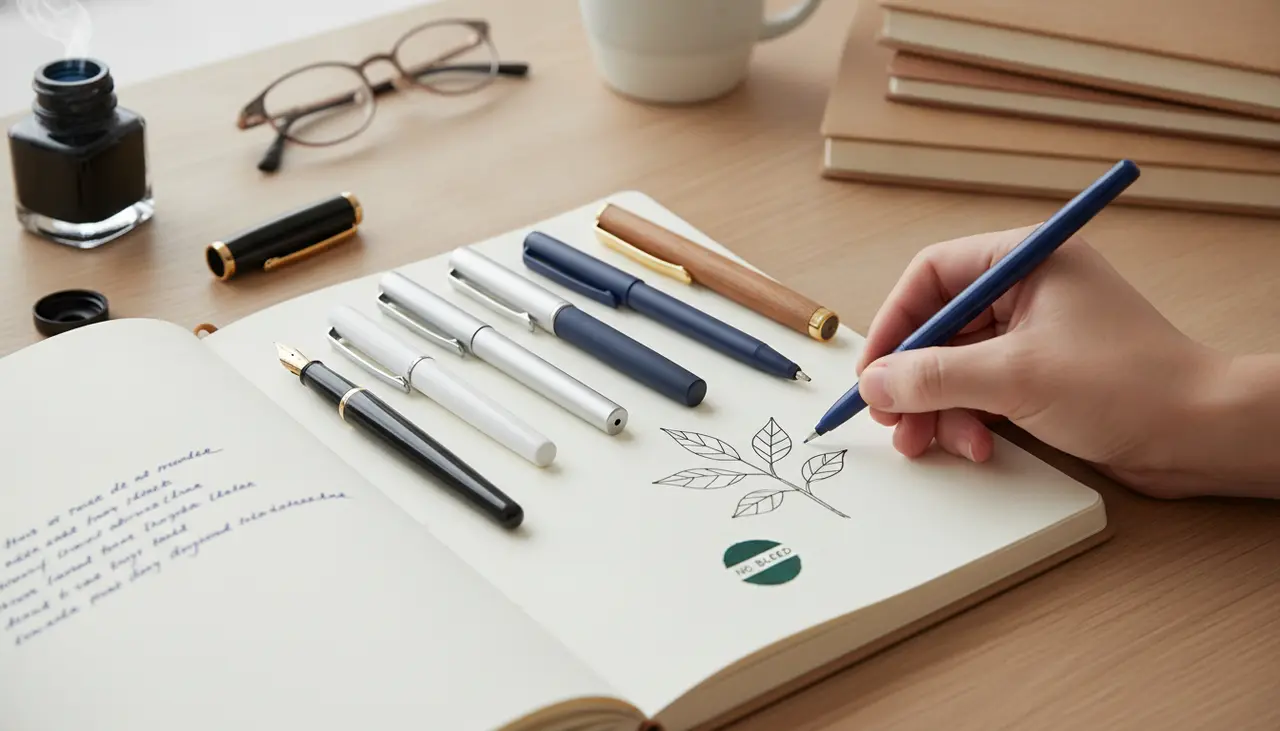
5 Best Pens for Journaling That Won't Bleed Through
Finding the perfect pen for your journal can feel a bit like searching for a quiet moment in a busy house—it’s a challenge, but oh-so-worth it when you finally find it. If you’ve ever poured your heart out onto a page only to flip it over and find "ghosting" or ink bleeding through to the other side, you know how discouraging that can be. It makes you hesitant to write on the next page, and honestly, your thoughts deserve better than that.
The best pens for journaling that won't bleed through are typically those with pigment-based gel inks or fine-point felt tips. These pens are designed so the ink sits on the surface of the paper fibers rather than soaking deep into them. Specifically, the Sakura Pigma Micron and the Zebra Sarasa Mark ON are gold standards for clean, bleed-free writing on almost any paper thickness.
Why Your Pen Choice Matters for Your Journaling Habit
This guide is for the daily reflectors, the list-makers, and the creative souls who find peace in a paper notebook. Whether you are using a high-end leather journal or a simple notebook you picked up at the grocery store, the frustration of ink bleed is universal.
I’ve spent years testing different nibs and ink formulas, and I’ve learned that you don't need to spend a fortune to get a clean experience. You just need a pen that respects the paper you’re using. If you are also looking ahead to organize your year, you might find our 2027 Planner Preview: A Comprehensive Guide to Choosing Your Next Analog System helpful for finding the right canvas for these pens.
Comparison of Top No-Bleed Journaling Pens
| Pen Model | Ink Type | Tip Size Range | Best Feature |
|---|---|---|---|
| Sakura Pigma Micron | Pigment Felt Tip | 0.15mm to 0.50mm | Archival quality; zero bleed |
| Zebra Sarasa Mark ON | Pigment Gel | 0.4mm to 0.5mm | Smudge-proof with highlighters |
| Uni-ball Signo 207 | Pigment Gel | 0.38mm to 0.7mm | Security ink; very smooth flow |
| Sharpie S-Gel | Gel | 0.38mm to 1.0mm | No-smear technology; comfortable grip |
| Pilot G2 (Ultra Fine) | Gel | 0.38mm | Readily available; crisp lines |
Disclosure: This post contains affiliate links. If you click through and make a purchase, I may earn a small commission at no extra cost to you. This helps keep Daily Pen Craft running!
1. The Reliable Classic: Sakura Pigma Micron
If you are terrified of ink showing through on the other side of the page, the Sakura Pigma Micron is your best friend. It doesn't use traditional liquid ink; it uses "Pigma" ink, which is chemically stable and waterproof.
- Best for: Very thin paper or those who like to sketch alongside their writing.
- The Tradeoff: Because it is a felt-style tip, it doesn't "glide" as fast as a ballpoint. It requires a gentle hand.
2. The Highlighter's Dream: Zebra Sarasa Mark ON
Many of us love to color-code our journals. The Mark ON is a specialized version of the famous Sarasa gel pen. It’s formulated to dry almost instantly and stay put, even if you run a highlighter over it five seconds later.
- Best for: Students and bullet journalers who use highlighters.
- The Tradeoff: It feels a bit more "toothy" (you feel the paper more) than standard gel pens.
3. The Smooth Operator: Uni-ball Signo 207 (Ultra Fine)
The Uni-ball Signo 207 uses a special "Super Ink" that gets trapped in the paper fibers, preventing check fraud and—more importantly for us—preventing the ink from spreading and bleeding through.
- Best for: Professional journals and long-form writing where comfort is key.
- The Tradeoff: The 0.7mm (medium) can sometimes ghost on very cheap paper, so I recommend sticking to the 0.38mm or 0.5mm for the cleanest look.
4. The No-Smear Hero: Sharpie S-Gel
Sharpie took their ink expertise and put it into a sleek gel pen. The S-Gel is famous for its "no bleed, no smear" promise. It’s a very modern-feeling pen with a wonderful rubberized grip that’s easy on the fingers during long sessions.
- Best for: Left-handed writers who struggle with smudging their work as they go.
- The Tradeoff: The body of the pen is a bit thicker, which might not fit in all planner pen loops.
5. The Accessible Choice: Pilot G2 (0.38mm Tip)
The Pilot G2 is everywhere for a reason—it’s dependable. However, the standard 0.7mm can be a bit "juicy" and cause bleeding. By switching to the 0.38mm (Ultra Fine), you get that same great Pilot experience with a much lower risk of ink soaking through.
- Best for: Daily tasks and quick notes when you need a pen you can find at any local shop.
- The Tradeoff: The ultra-fine tip can feel a bit scratchy if you press too hard.
Common Beginner Mistakes to Avoid
When you're starting to get serious about your stationery, it's easy to make a few "messy" mistakes. I've made them all! Here’s what to watch out for:
- Pressing too hard: Unlike ballpoints, most gel and felt-tip pens don't need pressure. Pressing hard forces more ink into the paper, which is the number one cause of bleeding.
- Using "Wet" Fountain Pens on Standard Paper: We love fountain pens here, but if you're using a "wet" nib on standard notebook paper, it will almost always bleed. For those moments, you might want to explore specific pairings like those mentioned in our Inkebara Caramel Review, which discusses how certain inks behave on different surfaces.
- Closing the Journal Too Quickly: Even "fast-drying" ink needs a second or two. Give your page a quick "fan" with your hand before closing it to avoid ink transferring to the opposite page.
Frequently Asked Questions
What is the difference between ghosting and bleeding? Ghosting is when you can see a faint shadow of your writing on the other side of the page, but the ink hasn't actually come through. Bleeding is when the ink physically soaks through the paper fibers to the other side.
Does paper quality matter more than the pen? It’s a partnership! However, a good "low-bleed" pen can make even cheap notebook paper perform better. If you have a journal you love with thin paper, a Sakura Pigma Micron is usually the safest bet.
Are gel pens better than ballpoints for journaling? Gel pens usually offer more vibrant colors and a smoother writing experience, but they contain more moisture. Ballpoints are the "safest" against bleeding but can feel stiff and require more hand pressure, which can lead to cramping.
Finding the right tool is a journey, and there’s no "wrong" answer as long as it makes you want to keep writing. If you’re just starting out, try a single Uni-ball Signo 207 or a Micron and see how your paper reacts. You’ve got this!