
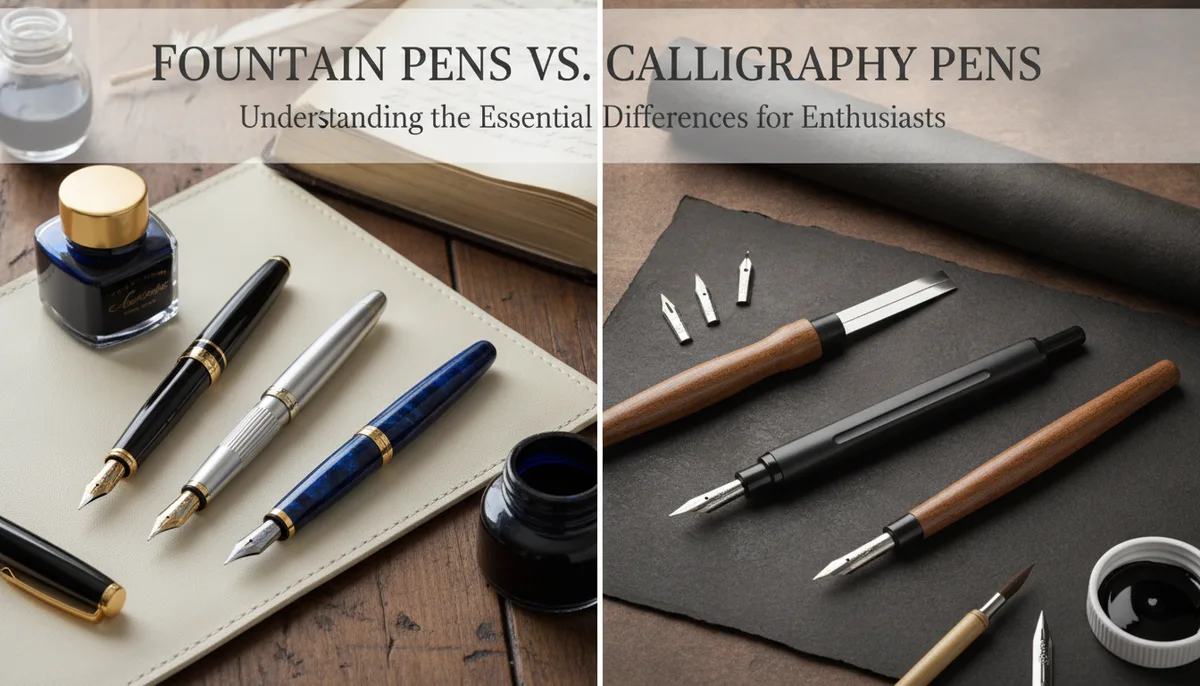
Fountain Pens vs. Calligraphy Pens: Understanding the Essential Differences for Enthusiasts
For anyone outside the fine writing community, pulling out a fountain pen almost always invites the exact same question: "Oh, is that for calligraphy?"
While both practices share a deep love for analog writing and beautiful line variation, they belong to completely separate worlds. For the uninitiated, the distinction might seem pedantic, but for the enthusiast, understanding these silos is the difference between a flourishing hobby and a ruined $200 instrument. Understanding the distinct categories of everyday writing, modern lettering, and traditional scripts helps enthusiasts choose the right gear, master the correct techniques, and protect their investments.
The Modern Writing Landscape: Defining the Styles
To understand these writing instruments, it helps to break handwriting down into distinct categories based on technique, intent, and tools. Each serves a specific purpose in an analog system, whether you are preparing for The 2027 Planner Preview: A Comprehensive Guide to Choosing Your Next Analog System or creating a piece of fine art.
Everyday Writing & Fountain Pens
Fountain pens are highly practical, utilitarian tools engineered for signatures, daily journaling, and note-taking. Instead of requiring a separate bottle on your desk, they prioritize portability, convenience, and seamless personal expression with automatic internal ink flow. They are designed to be "always ready," making them the ideal companion for professionals and students alike.
Hand Lettering
Often celebrated as a modern decorative aesthetic, hand lettering is fundamentally about drawing letterforms rather than executing them in a single, fluid stroke. Utilizing brush markers, felt tips, or fine-liners, it serves as a creative, stylized bridge connecting standard handwriting to formal calligraphy. In lettering, you might go back over a line to thicken it; in calligraphy, that thickness must be achieved in the initial stroke.
Traditional Calligraphy
This is a strictly disciplined, highly formal craft defined by rigid historical standards. Achieving complex scripts like Copperplate or Spencerian demands highly specialized tools, intense focus, and precise pressure execution. It is less about "writing" a message and more about "constructing" an aesthetic tradition.
Hardware Breakdown: Nibs and Feeds
While both fountain pens and calligraphy tools rely on metal nibs to deliver fluid ink onto paper, their mechanical designs and lifespans part ways dramatically.
Ink Storage vs. Manual Dipping
Fountain pens house internal reservoirs—such as cartridges, converters, or pistons—paired with a complex feed system to regulate a steady, uninterrupted flow of ink. This "feed" is a piece of plastic or ebonite with microscopic channels that use capillary action to pull ink to the nib.
Calligraphy sets are typically dip pens. The instrument is simple, lightweight, and requires the writer to repeatedly submerge the raw tip into an external inkwell as they work. There is no internal "engine" to regulate the flow; the writer must manage the ink load through technique and the surface tension of the nib itself.
Lifespan and Materials
The metallurgy of these tools is vastly different. Calligraphy nibs are crafted out of spring steel to achieve intense flexibility for dramatic downstrokes. Because they are meant to be flexed to their limits and are frequently exposed to harsh, pigmented inks, they are prone to corrosion and physical wear. They are designed to be swapped and discarded frequently.
Conversely, fountain pen nibs are made from resilient stainless steel or gold, often tipped with hard metals like iridium. They are built to endure a lifetime of use without needing replacement. While some fountain pens offer "flex" nibs, they rarely match the extreme range of a dedicated calligraphy dip nib.
Angles and Ergonomics: The Physical Approach
The way you hold the pen changes based on the result you want to achieve. Standard fountain pens utilize straight bodies designed for conventional writing postures, typically held at a 45-to-55-degree angle to the paper. This allows for long writing sessions without hand fatigue.
Achieving the extreme slants needed for classic formal scripts often requires an oblique or offset pen holder. These holders feature a brass flange that sticks out to the side, positioning the nib at an angle that allows the writer to achieve heavy downstrokes without snagging the paper or contorting their wrist. If you are looking to elevate your kit with more traditional tools, you might see these showcased at events like The DC Pen Show Edition: Elevating Your Writing Kit with New Lamy, Blackwing, and Nahvalur Releases.
The Golden Rule: Ink Matters
The absolute most critical distinction to keep in mind comes down to liquid chemistry. Substituting one ink for another can completely compromise your equipment.
Calligraphy Inks: The Fountain Pen Killers
Formulated to cling tightly to raw metal tips, dip pen inks are thick and pigment-based. They often utilize heavy binders like shellac, acrylic, or gum arabic to ensure the ink doesn't just "blob" off the nib. Inside the incredibly narrow tolerances of a fountain pen feed, this mixture acts like sludge or permanent superglue. Once shellac-based ink dries inside a fountain pen, it is almost impossible to remove without professional intervention, often entirely clogging and ruining the internal mechanics.
Fountain Pen Inks: Engineered Fluidity
These formulas are water-based, highly fluid, and rely on completely soluble dyes. They glide safely through capillary channels without blocking them, making them easy to clean out during regular maintenance. Because they are thinner, they also allow for unique properties like "shading," where the ink pools in different densities. A perfect example of this is explored in our Inkebara Caramel Review: A High-Shading Brown with a Sophisticated Dry Flow.
Two Different Communities
This technical divergence also shapes how enthusiasts gather. In calligraphy-centric groups, the ultimate focus remains squarely on the individual artist's technique, precision, and the elegance of every stroke. The tool is a means to an end—a consumable part of the artistic process.
In contrast, the fountain pen community often leans toward the appreciation of the instruments themselves—their filling mechanisms, the materials of the barrels (like precious resins or celluloid), and the engineering of the nibs. While "penmanship" is valued, the joy is often found in the tactile experience of the pen meeting the paper during everyday tasks.
Which Should You Choose?
If your goal is to write letters to friends, take beautiful notes in a meeting, or maintain a daily journal, a fountain pen is your best investment. It offers the elegance of a liquid-ink system with the convenience of a modern ballpoint.
If you want to create wedding invitations, master the art of 18th-century Spencerian script, or produce high-contrast flourishings, a calligraphy dip pen is the correct tool. It provides the flexibility and ink density that a fountain pen simply cannot replicate.
Regardless of which path you choose, the most important step is respecting the chemistry of your tools. Keep your India inks for your dip pens and your dye-based inks for your fountain pens, and your writing journey will be a smooth one.