
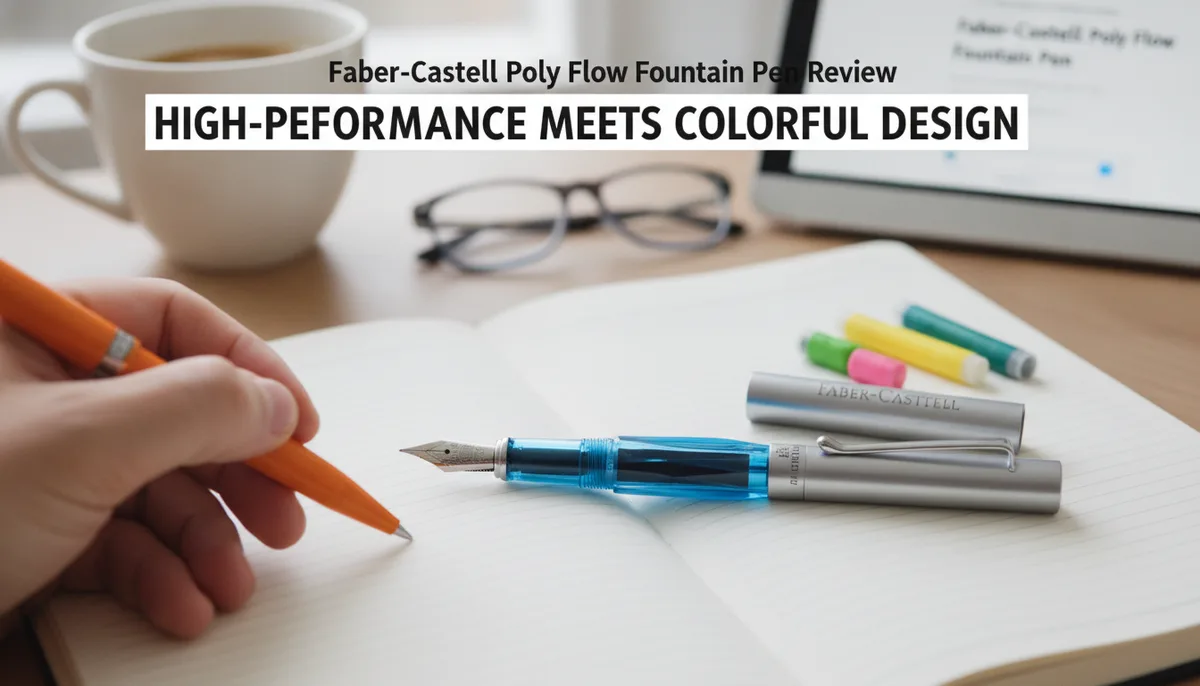
Faber-Castell Poly Flow Fountain Pen Review: High-Performance Meets Vibrant Design
The German Legacy of Accessible Excellence
In the world of fine writing, German stationery brands like Faber-Castell often occupy a dual space. On one hand, they are synonymous with luxury—producing high-end, heirloom-quality instruments that command premium prices. On the other hand, they possess a deep-rooted commitment to the "office and school" segment. This is where the real engineering magic often happens: creating a tool that is affordable enough for a student’s backpack but reliable enough for a professional’s desk.
The Faber-Castell Poly Flow Fountain Pen is a quintessential example of this philosophy. While the brand’s "Graf von Faber-Castell" line gets the headlines for its exotic woods and precious metals, the Poly series focuses on utility, ergonomics, and a splash of modern personality. At a price point of roughly $22, it enters a crowded market of "beginner" pens, yet it brings a level of nib refinement that challenges even its more expensive siblings.
Design and Material: The "Punchy Melon" Aesthetic
The first thing that strikes you about the Poly Flow is its visual energy. The "Poly" series is known for its firm, lightly-textured exterior barrel material. It isn't the slick, fingerprint-prone plastic found on some budget pens; instead, it offers a tactile grip that feels substantial in the hand despite its lightweight construction.
One of the standout features of this specific model is the colorway. The "Punchy Melon" variant features a vibrant purple and orange gradient that defies the often-stuffy reputation of fountain pens. If you find the traditional black or navy blue pens a bit too conservative for your creative process, the Poly Flow offers a refreshing alternative. However, for those who prefer the classics, Faber-Castell does offer a standard Black model.
Texture and Build Quality
The barrel’s texture serves a dual purpose. Beyond the aesthetic appeal, the slight "tooth" of the material ensures the pen doesn't slip during long writing sessions. This is particularly important for students or professionals who might be taking rapid-fire notes. Despite its plastic build, the pen feels durable enough to be "tossed in a bag" without the constant fear of cracking or catastrophic failure.
The Nib Experience: A Standout Performer
If the barrel is the body, the nib is the soul of a fountain pen. It is common to assume that a $22 pen might compromise on the nib to keep costs down, but Faber-Castell (much like their compatriots at LAMY or Pelikan) understands that a poor first experience can turn a user off from fountain pens forever.
The Poly Flow utilizes a #5 sized stainless steel nib and feed system. While it is currently only available in a Medium width, the performance is remarkably consistent.
The "Square" Tipping Advantage
Most entry-level nibs feature a purely round ball of tipping material at the point. This makes them very "forgiving"—you can rotate the pen slightly and it will still write. The Poly Flow, however, features a slightly square style of tipping.
This subtle geometric choice provides several benefits:
- Controlled Line Variation: While not a "stub" nib, the squareness offers a bit more character to your handwriting than a standard round nib.
- Precision: It feels more "controllable" on the page. For those who find Medium nibs to be too "runny" or broad, the Poly Flow’s tipping helps keep the ink exactly where you want it.
- Feedback: It provides a pleasant tactile response from the paper, letting you feel the stroke without it being "scratchy."
If you are curious about how different nib styles affect your writing, you might find our guide on Fountain Pens vs. Calligraphy Pens: Understanding the Essential Differences for Enthusiasts helpful for understanding the mechanics behind the tip.
Ergonomics: The Triangular Barrel Shape
A defining characteristic of the Poly Flow is its "rounded-edge triangle" shape. This geometry persists through the length of the barrel and into the grip section.
Why a Triangular Grip?
The goal of a triangular grip is to encourage a "tripod grip"—the traditional way of holding a pen with the thumb, index, and middle fingers. This reduces hand fatigue during long-form writing.
However, ergonomics are subjective. If you have a non-traditional grip (such as a "quadrupod" or a lateral wrap), you might find the ridges of the triangle a bit restrictive. Compared to the LAMY Safari Fountain Pen, the Poly Flow’s triangle is much softer and less aggressive. It’s an "optical illusion" of sorts; it looks more faceted than it feels, making it a comfortable middle ground for most users.
The Capping Mechanism
One practical quirk to note is the capping system. To ensure a tight seal and maintain the pen's streamlined look, you must align the ridges of the cap with the ridges of the barrel. If you try to snap the cap on haphazardly, you will feel resistance. It requires a quick rotation to "lock" it into place. While this adds a second to the process, it ensures the pen stays securely closed in your pocket or bag.
Ink Flow and Compatibility
The Faber-Castell Poly Flow is designed for versatility. It uses the Standard International cartridge/converter system. This is a massive advantage for users who don't want to be locked into a proprietary brand ecosystem.
Cartridges vs. Converters
Out of the box, the pen typically comes with a cartridge. However, to truly unlock the potential of a fountain pen, using a converter with bottled ink is the way to go. Note that the Poly Flow does not usually include a converter in the basic box, so you will want to pick one up separately.
The ink flow through the #5 feed is generous without being overwhelming. During testing, pairing the "Punchy Melon" model with a vibrant purple ink—like the one mentioned in our Inkebara Caramel Review—can create a "matchy-matchy" aesthetic that makes the writing experience even more enjoyable.
Value Comparison: How Does It Stack Up?
At the $20–$30 price point, the competition is fierce. You have the Pilot Metropolitan Fountain Pen, which offers a classic metal body, and the TWSBI ECO Fountain Pen, which offers a massive ink capacity.
So, where does the Poly Flow fit in?
- Over the Pilot Metropolitan: The Poly Flow is lighter and offers a more modern, playful design. Its #5 nib also feels a bit more "German" (slightly broader and wetter) than the finer Japanese nibs on the Pilot.
- Over the LAMY Safari: The Poly Flow offers a smoother, less polarizing grip and a nib that many find to be more consistent out of the box.
- Over the TWSBI ECO: The Poly Flow is more "toss-able." Because it uses cartridges, it’s easier to maintain for a student or a traveler who doesn't want to carry ink bottles.
Final Thoughts: A Punchy Addition to Your Kit
The Faber-Castell Poly Flow is a testament to the idea that you don't need to spend three figures to get a world-class writing experience. It’s a pen that doesn't take itself too seriously aesthetically, yet performs with the seriousness of a high-end German instrument.
Whether you are looking for your first fountain pen or you are a seasoned collector looking for a reliable "beater" pen that can handle the rigors of daily travel, the Poly Flow is a standout choice. It’s fun, it’s functional, and most importantly, it writes beautifully.
Pros:
- Excellent #5 nib with unique "square" tipping.
- Standard International compatibility.
- Soft triangular ergonomics.
- Vibrant, modern color options.
Cons:
- Only available in Medium nib.
- Cap requires specific alignment to close.
- Converter usually sold separately.
If you’re planning your next stationery haul or looking to upgrade your analog setup, don't forget to check out The 2027 Planner Preview: A Comprehensive Guide to Choosing Your Next Analog System to find the perfect paper to pair with your new Poly Flow.