
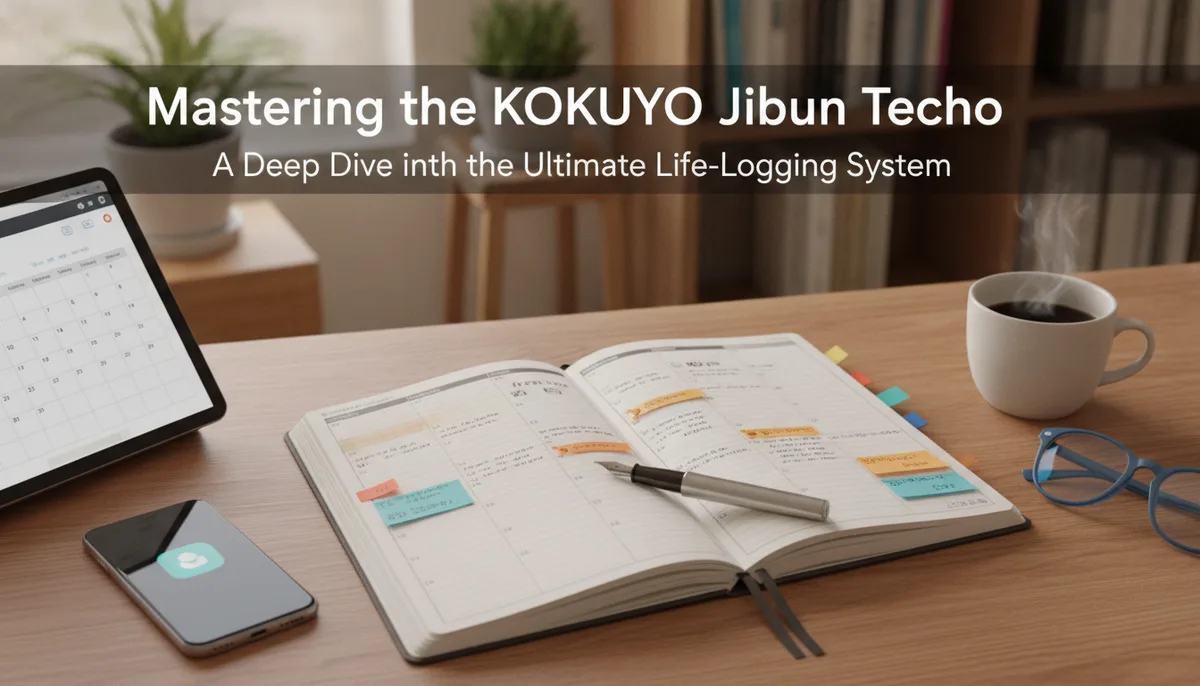
Mastering the KOKUYO Jibun Techo: A Deep Dive into the Ultimate Life-Logging System
The world of Japanese stationery is vast and often overwhelming, but few items command as much respect and curiosity as the KOKUYO Jibun Techo. For the uninitiated, the Jibun Techo is more than just a planner; it is a meticulously engineered "life-logging" system. However, its dense vertical layout and multi-book structure can feel intimidating to first-time users.
To truly understand the Jibun Techo, one must look at it through the eyes of its creator, Hideaki Sakuma. In collaboration with KOKUYO—a company with a 120-year legacy of helping people express themselves—Sakuma designed a tool that bridges the gap between a simple calendar and a lifelong archive.
The Philosophy of "Jibun": More Than Just a Schedule
The term Jibun (自分) translates to "self," and Techo (手帳) means "notebook." Combined, the name signifies a "notebook for yourself." Unlike standard planners that focus solely on professional deadlines or academic tasks, the Jibun Techo is designed to hold your entire identity.
KOKUYO’s core value has always been centered on self-expression. In a world increasingly dominated by fleeting digital notifications, the Jibun Techo offers a tactile, permanent record of who you are. This philosophy is why the system is often split into three distinct parts: the DIARY, the LIFE, and the IDEA.
While many users start with just the DIARY, the full power of the system is realized when you use all three. The LIFE booklet, in particular, is meant to be carried forward year after year, containing records of anniversaries, life goals, and even medical history. This long-term vision is what sets the Jibun Techo apart in a market full of disposable annual planners. If you are currently weighing your options for the upcoming season, our The 2027 Planner Preview: A Comprehensive Guide to Choosing Your Next Analog System provides further context on how the Jibun Techo fits into the broader landscape of analog tools.
Decoding the Vertical Layout: Tips from Hideaki Sakuma
The most striking—and sometimes polarizing—feature of the Jibun Techo is its 24-hour vertical timeline. For those used to horizontal boxes, the narrow columns can feel restrictive. However, creator Hideaki Sakuma views this layout as a way to visualize time as a continuous flow.
Visualizing Your Day
Sakuma’s primary tip for first-time users is to stop viewing the planner as a list of chores and start viewing it as a map of your energy. By using the 24-hour timeline, you can see exactly where your "dead time" is and where you are overextending yourself.
The Use of Color and Icons
The Jibun Techo is famous for its "mood" icons and weather trackers at the top of each day. Sakuma encourages users to fill these out daily. Over months, these small data points reveal patterns: Does your productivity drop on rainy days? Does your mood improve when you log more sleep? This is the "logging" aspect of the system that transforms it from a planner into a personal data lab.
The Three-Book System: DIARY, LIFE, and IDEA
To master the Jibun Techo, you must understand how the three components interact. While they are often sold together in a "First Kit," they serve very different psychological purposes.
1. The DIARY: The Heart of the System
This is the core booklet containing the 24-hour vertical weekly spreads, monthly calendars, and various tracking pages (like project managers and book lists). This is where your "now" lives. Sakuma designed the DIARY to be used with "THIN paper," which is incredibly lightweight yet resistant to bleed-through—a necessity for those who prefer using fountain pens or heavy gel inks.
2. The LIFE: Your Permanent Record
The LIFE booklet is the most unique aspect of the Jibun Techo. It includes pages for:
- Life's Dreams: A bucket list for your entire existence.
- Anniversaries: A place to record birthdays and milestones that don't change year-to-year.
- Medical History: A vital record for long-term health tracking.
- Travel Maps: To visualize where you have been.
The idea is that when the year ends, you move your LIFE booklet into your new DIARY cover.
3. The IDEA: The Space for Chaos
The IDEA booklet is a simple grid-paper notebook. It is intended for brainstorming, journaling, or meeting notes—things that don't fit into the structured columns of the DIARY. By separating these "messy" thoughts into a different booklet, the DIARY remains a clean, organized record of your time.
Paper Quality and the Writing Experience
KOKUYO's 120-year history is evident in the technical specifications of the Jibun Techo. The choice of paper is a frequent point of discussion among stationery enthusiasts. The "THIN paper" used in the standard Jibun Techo was developed specifically to reduce the bulk of a 3-book system while maintaining high performance.
For those who enjoy the nuanced shading of inks, the Jibun Techo's paper offers a surprising amount of character. If you are a fountain pen user, you might find that a high-shading ink like those discussed in our Inkebara Caramel Review: A High-Shading Brown with a Sophisticated Dry Flow performs beautifully on this paper, allowing for a sophisticated look in your daily logs.
Choosing the Right Jibun Techo for Your Lifestyle
Over the years, KOKUYO has expanded the lineup to accommodate different tastes. Choosing the right one is the first step toward a successful planning habit.
- The Standard (Original): Features the colorful "Pale Color" scheme and the full 3-book system. Best for those who love the classic Jibun aesthetic and want to track everything.
- The Biz: Designed for a professional environment. It uses a more muted color palette (mostly grays and blacks) and "MIO paper," which dries faster—perfect for left-handed writers or those using quick-drying gel pens.
- The Lite: A simplified, all-in-one version. It combines the most essential elements of the DIARY into a single, slim book. It uses "HIZEN" paper and is ideal for those who find the 3-book system too bulky.
- The Days: A daily version of the Jibun Techo that uses a unique "T-shape" timeline down the center of the page, allowing you to separate your schedule from your to-do list.
Practical Guidance: How to Start Without Burnout
The biggest mistake new users make is trying to fill every single box from day one. Sakuma suggests a "low-pressure" entry point.
- Start with the "Must-Dos": Only record your fixed appointments for the first two weeks.
- Log After the Fact: If you forget to plan your day, use the vertical columns to record what you actually did. This is "life-logging" and is just as valuable as planning.
- Don't Fear White Space: A blank column doesn't mean a wasted day; it means a day where you had the freedom to exist without a schedule.
The Jibun Techo is a tool for self-discovery. By using the vertical format to track your time, the mood icons to track your feelings, and the LIFE booklet to track your legacy, you create a comprehensive portrait of your life. Whether you are using a standard ballpoint or exploring the differences in Fountain Pens vs. Calligraphy Pens, the Jibun Techo provides a canvas that grows with you.
Conclusion: A 120-Year Legacy in Your Pocket
KOKUYO’s commitment to self-expression is realized fully in the Jibun Techo. By following Hideaki Sakuma’s vision of a "notebook for the self," users can move beyond simple time management and into a practice of mindful living. The vertical layout, once mastered, becomes a powerful lens through which to view your life, making the Jibun Techo not just a planner, but a lifelong companion.