
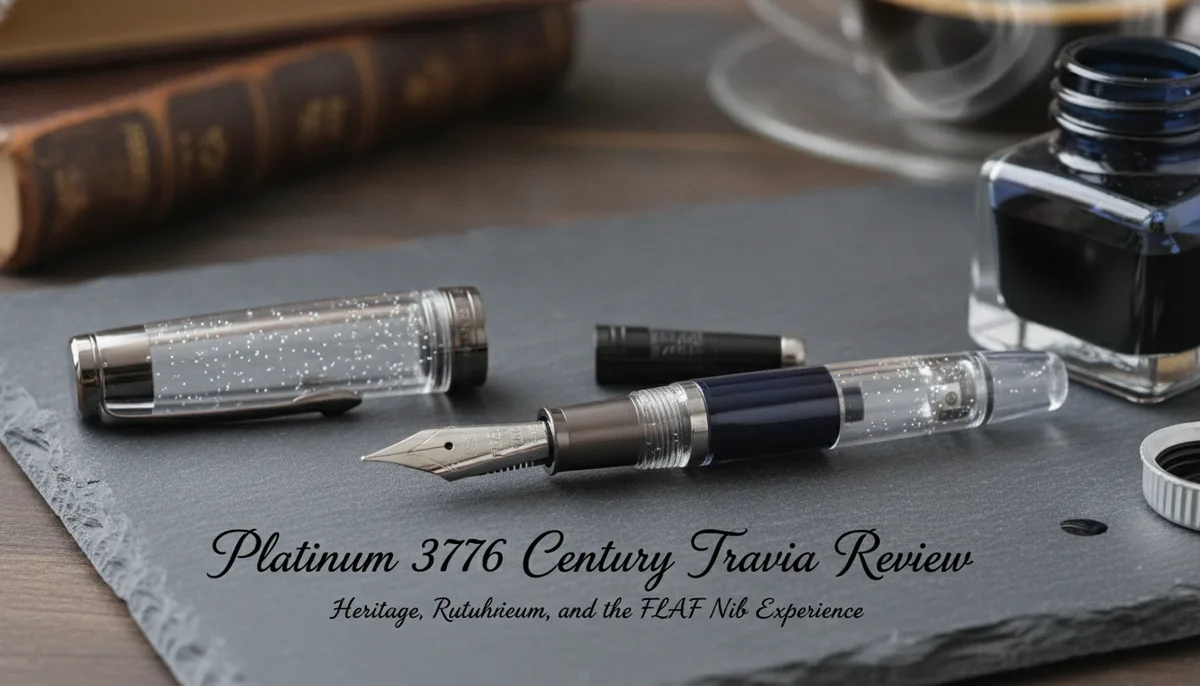
Platinum 3776 Century Travia Review: Heritage, Ruthenium, and the FLAF Nib Experience
When Bryce Gillet from Luxury Brands of America reached out with a tester set of Platinum 3776 pens, I knew I was in for a treat. But tucked away in the shipment was something even more intriguing: the new Platinum 3776 Century Travia.
As someone who has tumbled headfirst down the stationery rabbit hole (and honestly, I’m quite happy down here, thank you very much), I’ve spent a lot of time with the standard 3776 lineup. However, the Travia isn't just another colorway. It is a calculated nod to the brand's history, specifically the original 1978 version of the 3776, combined with modern metallurgical experiments.
I’ve spent several days handwriting my impressions to truly get a feel for this pen. In the world of fine writing, "feel" is everything—and the Travia feels like a very deliberate departure from the status quo.
The Heritage of "Tradition and Path"
The name "Travia" is derived from the words "Tradition" and "Via," the Latin word for path. Platinum Japan describes this as an "evolving road that extends straight into the future." This isn't just marketing fluff; it’s reflected in the very presentation of the pen.
Inside the box, you’ll find more than just a writing instrument. The first 2,000 sets include a book titled "Ah, Fifty Years of Hardship," written by Platinum’s founder, Shunichi Nakata. Translated into English, this book offers a rare, intimate look at the struggles and triumphs of building one of Japan’s most iconic pen brands. It adds a layer of soul to the purchase—you aren't just buying a pen; you’re buying a piece of a fifty-year legacy.
If you are a collector who values the narrative behind your tools, this limited-edition set is a significant draw. Once those 2,000 sets are gone, the book will no longer be included, making this initial run a true "path" back to the company’s roots.
Aesthetic Evolution: Ruthenium and Flat Finials
At first glance, the Travia looks like a sleek, stealthy version of the classic 3776 Century. However, the differences are immediate once you hold it.
The Ruthenium Trim
The most striking visual element is the ruthenium-plated trim. Unlike the bright gold or rhodium usually found on these pens, the dark metallic grey of ruthenium paired with the polished black acrylic creates a sophisticated, "executive" aesthetic. It’s understated but high-end.
Flat Ends vs. Cigar Shape
The standard 3776 is known for its "cigar" shape—rounded finials on both the cap and the barrel. The Travia breaks this mold by featuring flat ends. This design choice is a direct callback to the 1978 original 3776. It gives the pen a more architectural, modern silhouette while simultaneously paying homage to its vintage ancestor.
The Matte Grip
One of my favorite functional design choices here is the grip section. While the rest of the pen is polished acrylic, the grip is a matte black. For those of us who suffer from "sweaty-finger syndrome" during long writing sessions, or for those who find polished metal or plastic grips too slippery, this matte texture provides excellent purchase and control.
Weight and Balance: A Technical Breakdown
The Travia is not just a visual redesign; it’s a re-engineering of the pen’s balance. Platinum has used ruthenium not just for the trim, but as a weighting element.
In the fountain pen world, weight distribution is often more important than total weight. The Travia is designed to be front-weighted when unposted. By placing the metal weight just above the grip section, Platinum has moved the center of gravity closer to the paper.
To understand how significant this change is, let's look at the specs I gathered during my testing:
| Pen Type | Cap Weight | Body Weight (Empty) | Total Weight (Posted) |
|---|---|---|---|
| Platinum Travia | 10.23 g | 19.57 g | 29.80 g |
| Standard 3776 | 10.43 g | 9.71 g | 20.14 g |
| Pilot Custom 823 | 9.68 g | 18.91 g | 28.59 g |
| Pelikan M800 | 8.66 g | 20.44 g | 29.10 g |
The data reveals something fascinating: the Travia body is more than double the weight of a standard 3776 body. It actually puts the Travia in the same weight class as "heavy hitters" like the Pelikan M800 and the Pilot Custom 823.
For many enthusiasts, the standard 3776 can feel a bit light or "plasticky." The Travia solves this. It has a density that feels premium and substantial in the hand. However, there is a caveat for those who like to post their pens. When you post the cap, the weight moves significantly toward the back. For my small-to-medium hands and my steep writing angle, the posted Travia felt top-heavy and off-balance. If you prefer writing unposted, however, the front-weighting is sublime.
The FLAF Nib: "Floats Like A Feather"
The centerpiece of the Travia is undoubtedly the FLAF nib. This is not the standard 3776 nib, nor is it the new "Century 2.0" design. The "Floats Like A Feather" nib is a specialized ruthenium-plated 14k gold nib designed for a specific tactile response.
If you’ve ever used a standard Platinum nib, you know they are famous for their "feedback"—that pencil-like feel on the paper. You also know they tend to be quite stiff. On the other end of the spectrum is the Platinum Soft Fine (SF), which is bouncy and expressive but can be difficult to control for everyday note-taking.
The FLAF nib sits right in the "Goldilocks zone":
- Stiffness vs. Bounce: It isn't as rigid as the standard 3776, but it isn't as "mushy" as a Soft Fine. It provides just enough give to make the writing experience feel cushioned.
- Control: The nib is intended to give the writer better control when varying pressure. It responds to the hand’s nuances without feeling like it’s getting away from you.
- Plating: The ruthenium plating on the nib matches the trim, giving the entire pen a cohesive, dark-mode look.
When comparing this to other specialized nibs, such as those found in our guide on Fountain Pens vs. Calligraphy Pens: Understanding the Essential Differences for Enthusiasts, the FLAF stands out as a "daily driver" nib that offers a hint of character without the learning curve of a flex or stub nib.
The Writing Experience: Small Hands vs. Large Hands
As I mentioned, I tend to hold my pens close to the nib and write at a steep angle. For my ergonomics, the Travia unposted is a dream. The weight sits right in the web of my hand, and the matte grip ensures my fingers don’t slide down onto the nib.
However, the Travia is a versatile beast. Because of the way the ruthenium weighting is distributed, writers with larger hands who prefer to hold the pen further back will likely find the balance point very accommodating.
When it comes to ink flow, the Travia maintains Platinum’s reputation for reliability. It includes the "Slip & Seal" mechanism in the cap, which prevents the nib from drying out even if the pen sits unused for months. I tested it with the included Platinum Blue-Black cartridge, but this pen would pair beautifully with a high-shading ink. If you’re looking for a sophisticated pairing, consider something like the Inkebara Caramel, which offers a dry enough flow to compliment the FLAF nib’s precision while providing beautiful shading on the page.
Inkebara Caramel Fountain Pen Ink
Final Thoughts: Is the Travia Worth It?
The Platinum 3776 Century Travia is a "bridge" pen. It bridges the gap between the lightweight entry-level luxury of the standard 3776 and the heavy, oversized feel of flagship pens like the M800. It bridges the gap between 1978 heritage and 2024 innovation.
Who is this pen for?
- The Collector: If you want the "Fifty Years of Hardship" book and a piece of Platinum history, the limited set is a must-buy.
- The Tactile Writer: If you find standard nibs too stiff but soft nibs too difficult to control, the FLAF nib is a revelation.
- The "Un-Poster": If you write with your pens unposted and enjoy a front-weighted feel, this is one of the best-balanced pens on the market.
Who might want to skip it?
- Small-Handed Posters: If you have small hands and insist on posting your cap, the back-weighting of the Travia may lead to hand fatigue.
- Budget Seekers: The added ruthenium and limited-edition packaging come at a premium over the standard 3776.
The Travia is a confident step forward for Platinum. It shows a brand that isn't afraid to look back at its "hardship" and "tradition" while carving out a new "via" for modern enthusiasts. It’s a pen that demands to be used, not just displayed—and if you get your hands on one, I suspect you won’t want to put it down.