
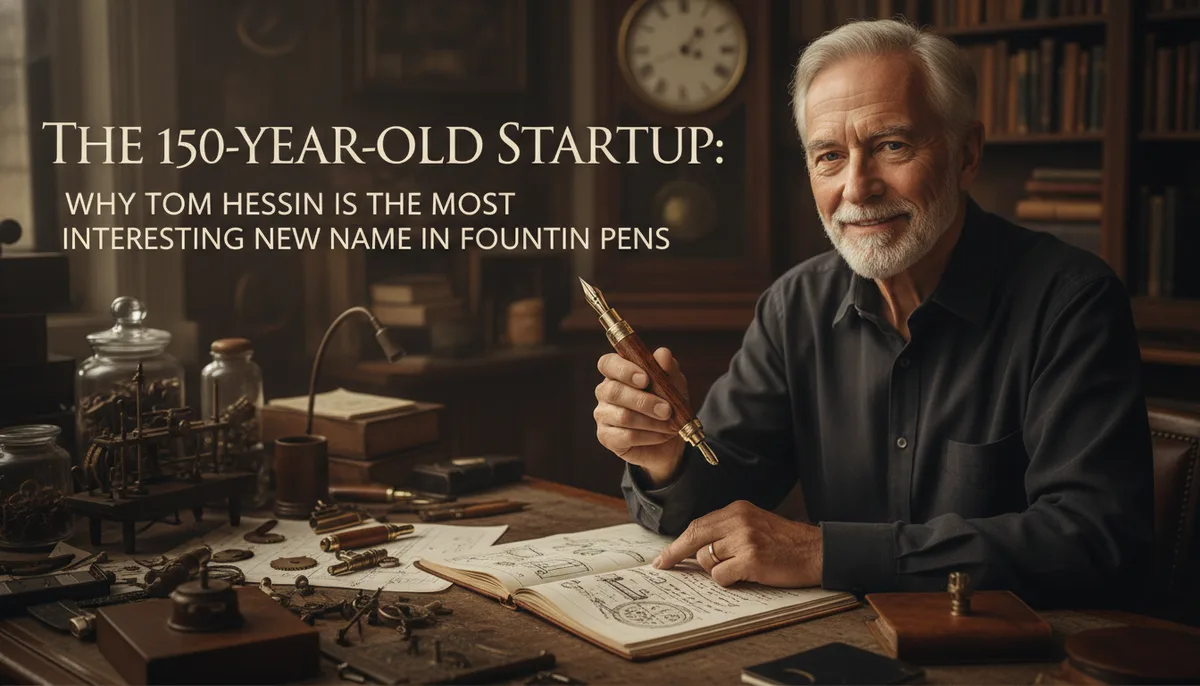
The 150-Year-Old Startup: Why Tom Hessin is the Most Interesting New Name in Fountain Pens
In an industry often dominated by established giants with centuries of marketing behind them, it is rare to witness the "birth" of a brand that arrives with 150 years of history already in its inkwell. Tom Hessin is exactly that—a 19th-century legacy reimagined for the 21st-century writer.
Recently, Charlie Stockbridge, the fifth-generation steward of this pen-making lineage, shared the story of the brand’s relaunch. It is a narrative that connects the soot-stained industrial heart of Victorian Birmingham to the polished desks of modern stationery enthusiasts. For those who appreciate the weight of history in their hand, Tom Hessin offers a unique proposition: the soul of an antique with the reliability of modern engineering.
The Birmingham Steel Pen Legacy: A 150-Year Foundation
To understand Tom Hessin, one must understand Birmingham in the late 1800s. At that time, the city was the undisputed global capital of pen making. More than 75% of the world’s pens were manufactured there, fueled by an industrial revolution that turned writing from a luxury for the elite into a tool for the masses.
Charlie’s great-great-grandfather, Tom Hessin Charles, was a central figure in this movement. Starting in 1870, the family began manufacturing writing instruments for a global market. While the brand name might feel new to the modern collector, the DNA of the company is deeply rooted in the technical precision of the Victorian era.
"It’s a relatively new brand in terms of what your audience will consider," Stockbridge notes, "but actually it’s got history going back over 150 years... in terms of my family and the five generations that we’ve been making writing instruments." This continuity is rare. In an era of "zombie brands"—old names bought by corporations to provide a veneer of heritage—Tom Hessin remains a true family affair.
Forged in the Archives: The 1896 Discovery
One of the most compelling aspects of the Tom Hessin relaunch is its commitment to authenticity. Rather than inventing a "vintage-style" aesthetic, the brand’s current identity is directly informed by a rediscovered 1896 archive brochure.
This archive serves as a library of names, color palettes, and design philosophies. For example, the "Thames Blue" seen in current collections isn't just a trendy shade; it is a color inspired by the rich tones found in those 19th-century records. This archival approach ensures that every pen is a tangible piece of the Stockbridge family’s journey.
Every Tom Hessin pen features a specific calling card: an engraved five-diamond motif on the clip. These diamonds represent the five generations of the family legacy, a subtle reminder that the pen in your hand is the result of 150 years of trial, error, and refinement.
Modern Heritage: Engineering Meets Artistry
The brand’s philosophy is defined as "Modern Heritage." This isn't just a marketing slogan; it describes the difficult balance between Victorian aesthetics and modern performance.
A Victorian pen, while beautiful, often lacks the convenience and reliability demanded by today's users. To bridge this gap, Stockbridge emphasizes technical precision. The development cycle for a new model can take up to 14 months, moving from archival concept to physical tool.
The JoWo Connection
Central to the performance of these pens is the use of JoWo nibs. In the world of fountain pens, the nib is the heart of the instrument. While some brands struggle with inconsistent "in-house" nibs, Tom Hessin’s choice of JoWo ensures a reliably smooth flow and high performance out of the box. This makes them excellent choices for those transitioning from standard office pens to something more substantial. If you are curious about how these stack up against other specialized tools, you might find our guide on Fountain Pens vs. Calligraphy Pens: Understanding the Essential Differences for Enthusiasts helpful for contextualizing nib performance.
Exploring the Tom Hessin Collections
The current catalog is divided into four distinct series, each serving a different aesthetic and functional purpose.
1. The Charles Collection
Named after the family patriarch, this collection features high-grade European resins. The Birmingham Noir and Castle Claret are standout models that pay direct homage to the brand's industrial roots. These pens feel substantial and professional, designed for the "daily carry" of a serious writer.
2. The Rebel Series
Designed for a broader, perhaps younger audience, the Rebel Series utilizes metal bodies and vibrant colors. Options like Garrison Green and Jewellers Rouge offer a more contemporary feel while maintaining the brand's signature weight and balance.
3. The Edinburgh Collection
This series is a striking juxtaposition of architectural wood textures and metal. Inspired by the landscapes of Edinburgh, these pens appeal to those who enjoy tactile materials. The warmth of the wood provides a different writing experience than resin or metal, making it a favorite for long-form journaling.
4. The Revolution Collection
This is perhaps the most "industrial" of the sets. Featuring walnut wood barrels and gunmetal accents, the Revolution Collection is inspired by the spirit of the late 19th century. The dark, organic tones of the walnut pair beautifully with high-shading inks. For a perfect pairing, consider how these earthy tones would look alongside a sophisticated ink like the one featured in our Inkebara Caramel Review.
Accessible Luxury in a Crowded Market
One of the most refreshing aspects of Charlie Stockbridge’s vision is the commitment to "accessible luxury." While the materials—European resins, walnut wood, and precision-engineered components—suggest a high price tag, the brand aims to remain approachable for enthusiasts.
"It’s that mixture, that mesh of fashion and function," Charlie explains. "It’s got to look good, but it’s got to work."
By focusing on strict engineering tolerances and premium third-party components like JoWo nibs, Tom Hessin avoids the pitfalls of many "heritage" brands that prioritize style over substance. These are pens meant to be used, not just displayed. Whether you are filling out your 2027 Planner or signing a contract, the goal is a seamless writing experience.
Why Tom Hessin Matters Today
In a digital world, the act of writing by hand has become a form of "slow living." We choose fountain pens because we want to feel a connection to the page and to the history of communication.
Tom Hessin succeeds because it doesn't just sell a pen; it sells a 150-year-old story that you can continue. When you hold a Charles fountain pen, you are holding the result of a collaboration between Charlie and his father, a design refined through five generations of Stockbridges.
For the collector who has everything, or the newcomer looking for a first "serious" pen, Tom Hessin offers something rare: a brand that is genuinely new, yet deeply old. It is a Victorian start-up that has finally found its modern voice.