The Sculptor’s Hand: How Darrell Davis of D Squared Arts Reimagines the Bespoke Pen
In the world of bespoke fountain pens, the lathe is the undisputed king. Most independent makers rely on the rotational precision of the lathe to turn rods of acrylic, ebonite, or wood into the symmetrical cylinders we recognize as writing instruments. However, Darrell Davis of D Squared Arts has taken a different path—one that leads away from the machine and back to the primal tools of the sculptor.
Based in the vibrant maker community that often intersects with the work of Shawn Newton, Davis has carved out a niche that prioritizes the tactile, the emotional, and the hand-wrought. His journey from high school teacher to artisan blank maker and, finally, to a unique pen designer is a testament to the power of creative transitions.
From Caregiving to Craftsmanship: The D Squared Origin Story
The path to artistry is rarely linear. For Darrell Davis, the shift began with a profound personal transition. While teaching high school, Davis stepped away from his career to become a full-time caregiver for his father as his health declined. During this period of intense personal responsibility, a spark from his college years remained: his friendship with renowned pen maker Shawn Newton.
Newton, already established in the fountain pen community, recognized Davis’s background in art and suggested he try his hand at making pen blanks—the raw material rods that makers turn into pens. What started as a "filler job" to support his caregiving role soon revealed a deep-seated talent.
Davis’s degree in sculpture and ceramics provided a unique lens through which to view pen materials. When Newton challenged him to replicate the highly sought-after, striated look of vintage "Arco" celluloid, Davis didn't just imitate it; he engineered a process to ensure the layers wouldn't separate, a common "kink" in handmade resins. This technical success at the Arkansas Pen Show marked the official arrival of D Squared Arts in the stationery world.
The Striated Signature: Mastering the "Arco" Aesthetic
For many enthusiasts, the holy grail of pen materials is the striated celluloid used by the now-defunct OMAS brand. These materials feature shimmering, parallel layers that catch the light with a chatoyant depth. Creating a modern acrylic equivalent is notoriously difficult, as the bonds between the layers can be structural weak points.
Davis’s striated acrylics have become his signature. By testing every iteration to ensure structural integrity, he has provided the community with a reliable way to enjoy that classic, architectural aesthetic. These blanks are often used in special projects, such as the Hatch project, and serve as the foundation for his own pen models.
When selecting a pen made from these materials, enthusiasts often look for inks that complement the earthy, sophisticated tones of the resin. For those using Davis’s brown or golden striated pens, an ink like Inkebara Caramel Review: A High-Shading Brown with a Sophisticated Dry Flow provides a perfect tonal match, enhancing the vintage feel of the instrument.
Defying the Lathe: A Sculptural Approach to Pen Making
The most radical aspect of Darrell Davis’s work is his refusal to use a lathe for shaping. While a lathe ensures perfect circular symmetry, it can sometimes limit the organic potential of a form. Davis chooses instead to hand-shape his pens.
The Hybrid Process: Precision Meets Artistry
To ensure that his pens remain functional writing instruments, Davis doesn't abandon technology entirely. He utilizes Shawn Newton’s CNC machine for the "internals"—the drilling and threading. This ensures that the cap threads perfectly and the nib housing sits securely.
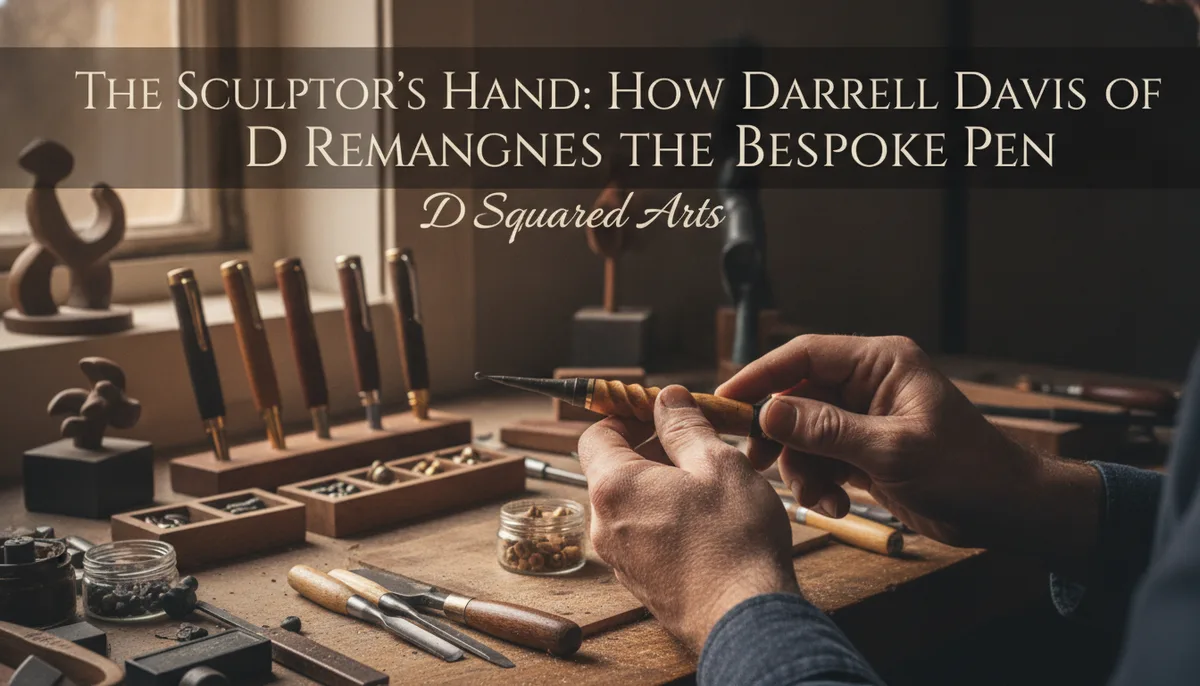
Once the technical foundation is set, the machinery stops. Davis employs a suite of traditional woodworking and sculpting tools:
- Scrapers: To remove fine layers of material.
- Rasps: To define the initial silhouette and rough geometry.
- Sandpaper: Used in a grueling hand-sanding process to preserve the subtle textures and "flaws" that give a handmade object its soul.
By hand-shaping, Davis can create facets, curves, and ergonomic grips that are impossible to achieve on a spinning lathe. This process is so unusual that Davis often demos it at pen shows, proving to skeptical collectors that his pens are indeed "carved" rather than "turned."
A Philosophy of Touch: Bringing Sculpture to the Hand
Davis’s background in ceramics and sculpture deeply informs his design philosophy. He often speaks about the "museum problem"—the frustration that beautiful sculptures are meant to be felt but are hidden behind "do not touch" signs.
"That’s one thing I like about making pens," Davis notes. "Someone will like to use and touch them."
This focus on the tactile experience is evident in his ceramic work as well, where he creates boxes that contrast rough, jagged exteriors with "fuzzy and warm" interiors. He views his pens through a similar lens: they are functional sculptures that must feel as good as they look. This philosophy aligns with the broader movement of "slow stationery," where the physical act of writing is a sensory escape from the digital world.
For those interested in how these tactile instruments differ from standard calligraphy tools, exploring the nuances in Fountain Pens vs. Calligraphy Pens: Understanding the Essential Differences for Enthusiasts can help clarify why a hand-shaped fountain pen offers a unique ergonomic experience.
Exploring the D Squared Arts Catalog: From Towers to Flowers
Davis’s models are not static; they evolve with every pen he carves. Because he doesn't use a fixed template on a lathe, each iteration of a model carries a slightly different "DNA."
The Lily
His first handmade pen was carved in the shape of a lily. While the initial labor-intensive process made it difficult to market, the maturity of his current techniques has allowed him to revisit these complex, floral-inspired commissions.
The Tour
Inspired by architecture and the game of chess, the Tour model (French for "tower") features a distinctive foot reminiscent of a rook. It reflects his admiration for Frank Lloyd Wright’s philosophy that every element of a design should be related.
The Cône and Tordré
The Cône is designed for the modern "fidgeter," featuring grooves in the ends specifically for thumb interaction. The Tordré, meanwhile, plays with visual perception, appearing to be twisted—a feat of manual carving that would be incredibly complex to program into a standard CNC workflow.
The Boo-boo
His newest model, the Boo-boo, draws inspiration from the world of cosmetics and perfume bottles, showcasing Davis’s ability to find "art" in everyday industrial design.
Why the "Maker Movement" Matters in 2027 and Beyond
As we look toward the future of analog tools, the role of the independent maker becomes even more vital. In a world of mass-produced plastic, a pen from D Squared Arts represents a connection to a specific person, a specific set of tools, and a specific moment in time.
Whether you are planning your year in a high-end system like those found in The 2027 Planner Preview: A Comprehensive Guide to Choosing Your Next Analog System or simply journaling at home, the instrument you hold changes the way you interact with your thoughts. Darrell Davis isn't just making pens; he’s making "emotional boxes" for our words—jagged or smooth on the outside, but always providing a warm, personal connection on the inside.
Conclusion: The Future of D Squared Arts
Darrell Davis continues to push the boundaries of what a "pen maker" can be. By bringing the sensibilities of a sculptor to the world of fine writing, he challenges us to look closer at the tools we use every day. His work reminds us that the most functional objects can also be the most personal.
If you ever find yourself at a pen show, look for the man at the wall table with a rasp in his hand. You won't just see a pen being made; you'll see a sculpture being born.