
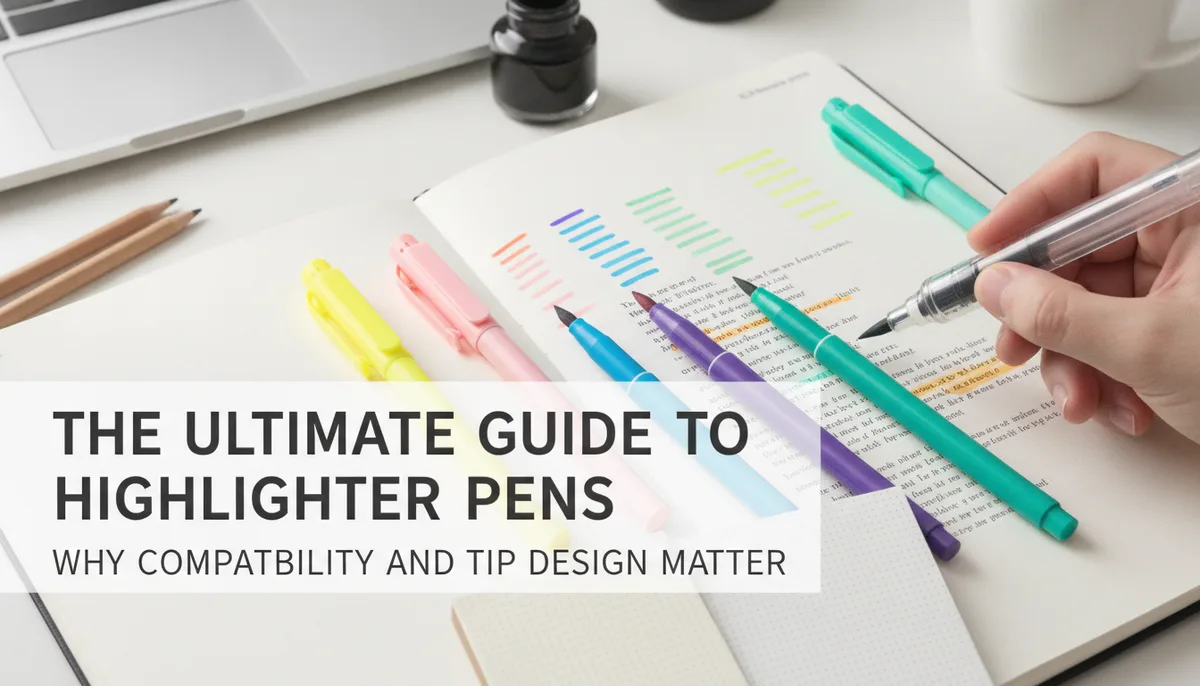
The Ultimate Guide to Highlighter Pens: Why Compatibility and Tip Design Matter
Highlighters are often dismissed as the simplest tool in a stationery kit, yet they carry the heavy responsibility of organizing our thoughts and emphasizing our most critical information. Whether you are a student diving into a dense textbook, a professional marking up a contract, or a planner enthusiast decorating a weekly spread, the quality of your highlighter can make or break the legibility of your work.
The frustration of a "smeared" note is universal. You spend time crafting the perfect sentence with your favorite gel pen, only to have a neon streak turn your hard work into an illegible gray smudge. Choosing the right highlighter is not just about picking a color; it is about understanding the synergy between ink types, paper quality, and tip ergonomics.
The Science of the Smear: Why Compatibility is King
The primary challenge in highlighter design is compatibility. Most highlighters use water-based inks, which can reactivate the dried ink of the pen used underneath. This is particularly common with gel pens and fountain pens, where the ink sits on the surface of the paper.
When looking for a tool that solves this issue, the Zebra Justfit Mojini Line stands out as a market leader. The engineering behind the Mojini Line is specifically focused on its impressive compatibility with all kinds of writing instruments.
The secret lies in the ink chemistry. The Mojini Line features ink that is formulated to bind with the ink of the pen underneath. Instead of picking up the pigment and dragging it across the page, the highlighter "locks" the writing in place. This makes it an essential tool for those who prefer dark, bold gel pens but still need the organizational benefits of highlighting.
Ergonomics and the "Justfit" Advantage
Beyond the chemistry of the ink, the physical design of the highlighter tip—the nib—plays a massive role in the user experience. Most traditional highlighters feature a rigid chisel tip. While effective on flat surfaces, these tips struggle when you reach the curved margins of a thick textbook or the inner gutter of a bound journal.
The Zebra Justfit series addresses this through a flexible tip design. Unlike a hard plastic or felt nib, the Justfit tip is designed to bend and conform to the surface of the paper. This ensures that the entire width of the chisel tip maintains contact with the page, resulting in a clean, consistent line regardless of the angle or the curvature of the book.
This flexibility is particularly useful for those preparing for long-term projects. If you are currently mapping out your year using The 2027 Planner Preview: A Comprehensive Guide to Choosing Your Next Analog System, you know that consistent marking is key to a clean, readable layout. A flexible tip prevents the "skipping" that often occurs at the edges of planner pages.
Matching Your Highlighter to Your Writing Tool
To choose the right highlighter, you must first look at what you are highlighting. Different pens require different highlighter technologies.
Highlighting Over Gel and Rollerball Pens
Gel pens are notorious for smearing because they use a high volume of water-based ink. For these, a smear-resistant highlighter like the Zebra Mojini is non-negotiable. If you use a pen with a heavy flow, wait at least 30 seconds for the ink to fully set before applying your highlighter.
Highlighting Over Ballpoint Pens
Ballpoint pens use oil-based ink, which is naturally more resistant to water-based highlighters. Almost any quality highlighter will work over a standard ballpoint pen. However, the Zebra Justfit Mojini Line remains a top choice here as well because its flexible tip provides a smoother gliding sensation over the slightly textured ink of a ballpoint.
Highlighting Over Fountain Pens
Fountain pen enthusiasts face the greatest challenge. Because fountain pen ink varies wildly in its water resistance, highlighting can be a gamble. If you are using a high-shading ink, such as those discussed in our Inkebara Caramel Review, you may find that traditional highlighters lift the beautiful shading properties of the ink. In these cases, it is often better to use a "dry" highlighter (colored pencil style) or a very light touch with a smear-resistant liquid highlighter.
Understanding the difference between your tools is vital. If you are curious about how different nib types affect ink delivery, you might find our comparison of Fountain Pens vs. Calligraphy Pens: Understanding the Essential Differences for Enthusiasts helpful in understanding how much ink your paper is actually absorbing.
The Role of Paper Quality in Highlighting
Even the best highlighter will fail on poor-quality paper. Paper "tooth" and absorbency dictate how the ink sits.
- Standard Copy Paper: Often very absorbent, which can lead to "feathering" (where the highlighter ink spreads out like a spiderweb) and bleed-through to the other side of the page.
- Premium Stationery Paper: Brands like Rhodia or Tomoe River have coatings that keep the ink on the surface. While this makes colors look vibrant, it also increases the dry time. Using a Zebra Justfit Mojini on this paper is ideal because the flexible tip prevents you from "scrubbing" the surface and damaging the coating.
- Glossy Paper: Highlighting on glossy textbook pages requires an ink that dries quickly via evaporation rather than absorption.
Rhodia A4 Meeting Book
Aesthetic Trends: From Neon to Muted Tones
For decades, the "fluorescent yellow" was the only game in town. While neon colors are scientifically proven to be the most eye-catching, they can also cause eye fatigue during long study sessions.
Modern stationery trends have shifted toward "Mild" or "Vintage" tones. These highlighters use softer palettes—dusty roses, olive greens, and cool grays—to provide emphasis without the visual harshness. The Zebra Justfit Mojini Line is appreciated not just for its performance, but for offering a range of shades that cater to this aesthetic preference.
When color-coding, consider a system where:
- Bright Yellow/Orange: Action items and deadlines.
- Blue/Green: Supporting facts and definitions.
- Pink/Red: Critical errors or "do not forget" points.
- Gray/Muted Tones: Finished tasks or secondary context.
Maintenance and Longevity: Getting the Most Out of Your Pens
To ensure your highlighters last as long as possible and maintain their smear-resistant properties, follow these three simple rules:
- Cap Immediately: Highlighter ink is designed to dry quickly. Even five minutes of exposure to air can cause the tip to "crust," leading to uneven ink flow.
- Clean the Tip: If you accidentally highlight over a wet pen and the highlighter tip becomes stained with black or blue ink, don't throw it away. Simply scribble on a piece of scrap paper until the tip clears.
- Store Horizontally: Storing highlighters horizontally ensures that the ink remains evenly distributed throughout the internal reservoir, preventing one end of the chisel tip from drying out while the other remains over-saturated.
Final Thoughts: Why the Zebra Justfit Mojini Wins
In the world of analog productivity, your tools should work for you, not against you. The Zebra Justfit Mojini Line earns its place as our top choice because it solves the two most common pain points in highlighting: ink smearing and tip rigidity.
By choosing a tool that respects the ink of the pens you already love and adapts to the physical shape of your books, you create a more seamless and enjoyable writing experience. Whether you are a student, an artist, or a professional, the right highlighter is a small investment that pays dividends in the clarity and organization of your most important ideas.