
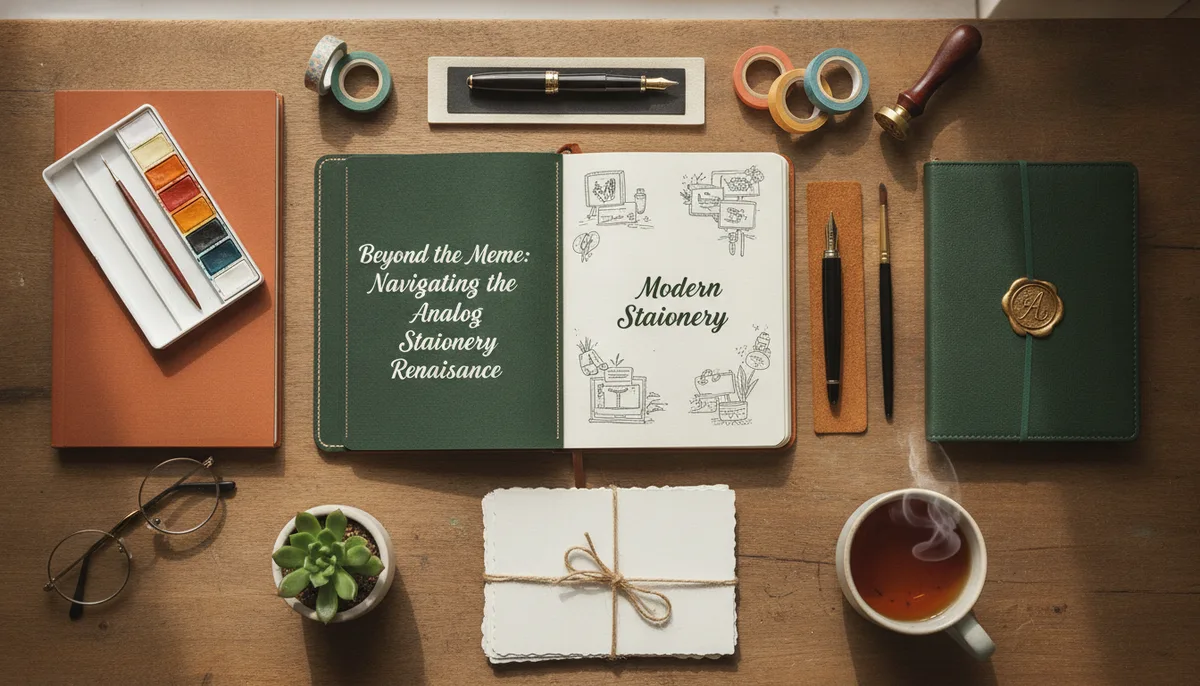
Beyond the Meme: Navigating the Modern Analog Stationery Renaissance
The digital age was supposed to be the end of paper. We were promised a paperless office, a digital-only workflow, and the obsolescence of the humble pen. Yet, looking at the vibrant community surrounding analog tools today, the opposite has occurred. We aren't just using paper; we are fetishizing it, documenting it, and building complex systems around it. From the "notebook meme" to the meticulous swatching of ink, the analog world is experiencing a sophisticated renaissance.
This movement isn't about rejecting technology; it’s about choosing a different pace. It’s about the tactile resistance of a nib on a page and the permanence of a handwritten letter. To understand this culture, we must look at the specific tools and rituals that define the modern enthusiast’s life.
The Psychology of the Notebook Meme
If you have a stack of twenty empty notebooks and just bought a twenty-first, you aren't alone. This phenomenon has become so prevalent it is now a foundational "meme" within the stationery community. As explored by Notebook Stories, our notebooks often become more than just paper; they are symbols of intent.
The "Meme of the Empty Notebook" suggests that we buy notebooks for the people we want to be. The leather-bound tome is for the novelist we hope to become; the pocket-sized memo book is for the observant flâneur we imagine ourselves to be on weekends. When we buy a new notebook, we are buying the potential of the blank page.
However, there is a shift toward actually using these tools. Enthusiasts are now sharing ways to "finish" their supplies, whether it’s a notebook or even a pencil. Learning how to finish an entire pencil, as discussed by Down the Breather Hole, is a lesson in mindfulness and sustainability. It’s a move away from pure consumerism and toward a deeper relationship with our tools.
The Art of the Swatch: Deep Diving into Ink Selection
For the fountain pen enthusiast, the ink is just as important as the pen itself. But an ink’s appearance in the bottle rarely matches its appearance on the page. This discrepancy has given birth to the "swatch culture."
Take, for example, a classic like Pilot Iroshizuku Asa-gao. A deep, vibrant blue, it is often a staple in many collections. But how does it compare to other blues in your stash? Swatching—using a glass dip pen or a cotton swab to apply a concentrated amount of ink to paper—reveals the hidden properties of the fluid: the "sheen" (a metallic surface color), the "shading" (variations in color intensity), and the "halo."
Choosing the right ink is a process of curation. Some enthusiasts, like those at The Gentleman Stationer, advocate for a "Keeper Ink" philosophy—narrowing down a massive collection to a few reliable workhorses that suit specific pens. If you are just starting your journey into the world of bottled colors, understanding the mechanics of how ink is delivered can be helpful. You might want to explore A Beginner’s Guide to Fountain Pen Ink: Cartridge vs. Bottle to decide which format fits your lifestyle.
Planning as Documentation: The Hobonichi Methodology
In the world of analog systems, the Hobonichi Techo stands as a titan. What started as a simple Japanese planner has evolved into a global movement. The magic of the Techo lies in its paper: Tomoe River paper. It is incredibly thin, allowing for a 365-day planner that isn't excessively bulky, yet it handles fountain pen ink with grace.
But for users like Abbey Sy, the Hobonichi isn't just a place to write down appointments; it’s a place to document a life. This is "memory keeping"—a hybrid of journaling, scrapbooking, and scheduling. By adding washi tape, stickers, and ink swatches, the planner becomes a time capsule.
As we look toward the future of these systems, the variety only increases. If you’re looking to dive into a new system for the upcoming year, checking out The 2027 Planner Preview: A Comprehensive Guide to Choosing Your Next Analog System can help you navigate the myriad of options, from the Graphilo Style notebooks to the classic Techo layouts.
The Mechanical Allure: Typewriters and Bespoke Pens
While notebooks and inks are the "software" of the analog world, the hardware—the pens and typewriters—provides the mechanical soul. There is a growing interest in the maintenance and preservation of these vintage machines. The opening of new stores, like the Northeast Typewriter Exchange, signals that there is a market for the clack and carriage-return of a manual typewriter.
Similarly, the world of fountain pens is moving toward the "bespoke." Enthusiasts are no longer satisfied with mass-produced items; they seek out pens that are works of art. This intersection of utility and sculpture is a hallmark of the modern hobby. For a deeper look at how these tools are crafted, you might find the story of Darrell Davis interesting in The Sculptor’s Hand: How Darrell Davis of D Squared Arts Reimagines the Bespoke Pen.
Even within the "standard" market, there is room for whimsy and theme. From ninja-themed fountain pens to glamorous badger-themed accessories, the tools we use are increasingly reflective of our personal eccentricities.
Curating the "Junk Drawer": Nostalgia and the Mundaneum
Why are we so drawn to the "giant junk drawer" of nostalgia? As seen in the work of Grace Baldwin and the archives of the Mundaneum, humans have an inherent need to categorize and save the mundane. The Mundaneum, an early 20th-century attempt to catalog the world’s knowledge on millions of index cards, was essentially a paper-based internet.
This impulse lives on in our "commonplace books" and our "Sunday Letter Projects." By writing letters or keeping index cards of our thoughts, we are participating in a long tradition of information management. We are sifting through the noise of the digital world to find the "grace" in the ordinary objects surrounding us.
Practical Mastery: Feeling Looser with Limited Materials
One of the traps of the stationery hobby is the "more is more" philosophy. We feel we need the perfect pen, the perfect ink, and the perfect paper before we can begin. However, as Comfortable Shoes Studio suggests, there is immense value in "feeling looser with limited materials."
When you limit your tools—perhaps just one sketchbook and one pen—you remove the paralysis of choice. You focus on the act of creation rather than the equipment. Whether you are using a new Stillman and Birn sketchbook for professional work or just doodling in a blank Graphilo Style notebook, the goal is the same: expression.
Summary of the Analog Workflow
To truly embrace this lifestyle, consider integrating these three practices:
- Intentional Acquisition: Buy the notebook, but assign it a specific job immediately.
- Ritualized Documentation: Use tools like the Hobonichi to bridge the gap between "to-do" and "have-done."
- Mechanical Appreciation: Take the time to understand your tools, whether it’s learning how to refill a bottle of ink or exploring the differences between a fountain pen and a calligraphy nib.
The "Misfill" of our lives—the extra links, the half-finished thoughts, the ink that didn't quite match the pen—is where the real magic happens. It’s in the messiness of the junk drawer and the smudge of a wet ink swatch that we find the human element that digital tools so often lack.