
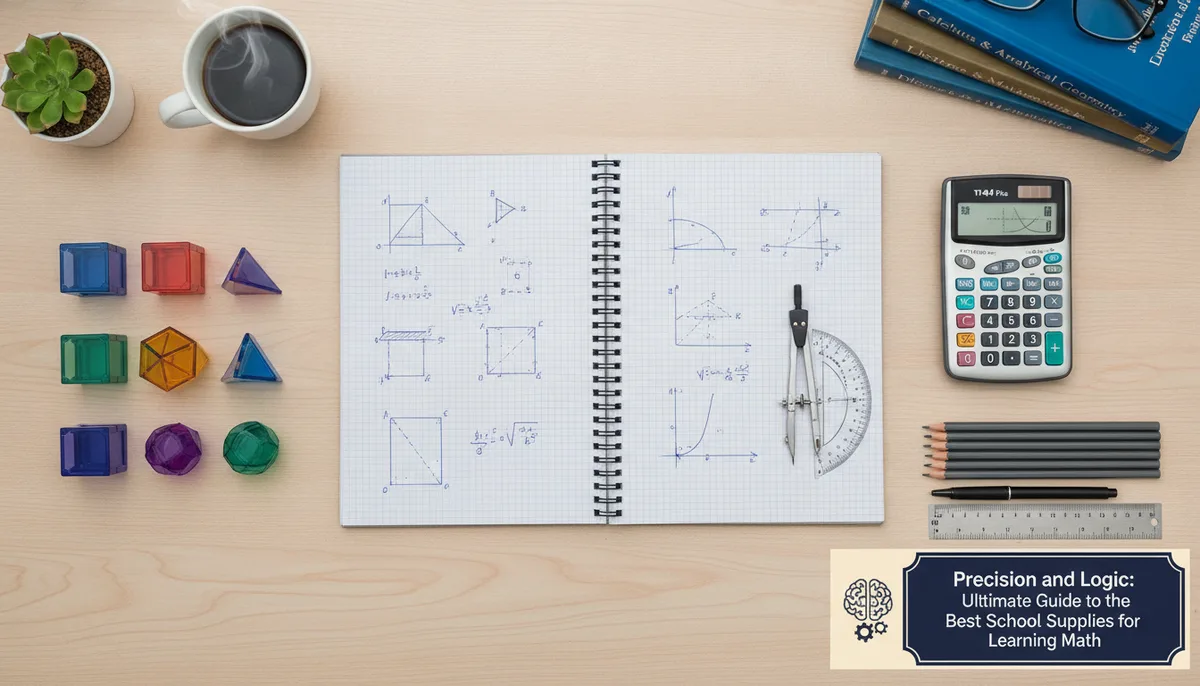
Precision and Logic: The Ultimate Guide to the Best School Supplies for Learning Math
Mathematics is often viewed as a purely mental discipline, a world of abstract numbers and invisible logic. However, any student who has spent hours wrestling with a complex calculus problem or a geometric proof knows that the physical tools you use can significantly impact your cognitive flow. Math anxiety is a well-documented phenomenon, and often, that frustration is compounded by poor-quality tools: lead that snaps constantly, paper that feathers under ink, or a binder that makes it impossible to organize various types of charts and formulas.
At Daily Pen Craft, we believe that the tactile experience of learning is fundamental to retention. By choosing the right school supplies, you remove the mechanical friction of the task, allowing your brain to focus entirely on the logic at hand. Whether you are a high school student tackling algebra or a university student diving into differential equations, this guide outlines the essential supplies designed to make math less frustrating and more intuitive.
The Foundation of Organization: Binders and Notebooks
In mathematics, organization is not just about neatness; it is about the ability to reference previous steps and visualize patterns. A standard spiral notebook often falls short because it lacks the flexibility to insert graph paper into a section of lined notes. This is where high-quality binder systems become indispensable.
The Versatility of Maruman Binders
When it comes to the best binders for learning math, Maruman stands out as a premier choice. Unlike the bulky, three-ring binders common in many classrooms, Maruman offers sleek, ergonomic designs that prioritize the writing experience.
The Maruman Kurufit, for instance, is exceptionally lightweight and flexible. For a math student, this means the binder can be folded back on a small desk, providing a stable writing surface without the intrusive "hump" of a traditional ring mechanism. This is particularly useful when drawing large-scale graphs or geometric figures where your hand needs a wide range of motion.
For those who require a more robust system for an entire semester of work, the Maruman Giuris or Clarté series offer sophisticated ways to categorize different mathematical modules—such as separating "Notes" from "Problem Sets" and "Reference Sheets."
Why Paper Texture Matters for Calculation
Not all paper is created equal. When performing rapid calculations, you want a "fast" paper—one that is smooth enough for a pencil or pen to glide across without catching, yet toothy enough to provide feedback. Maruman’s proprietary paper is legendary for its ability to handle both graphite and ink without bleed-through.
If you prefer a bound notebook over a binder, the Maruman Mnemosyne series is a gold standard. The subtle grey grids are dark enough to guide your sketches but light enough not to distract from your work. This balance is crucial when you are trying to identify the intersection of two lines on a coordinate plane.
The Best Pens and Pencils for Mathematical Precision
The debate between pen and pencil in math is long-standing. While pencils offer the safety of erasability, pens provide the high contrast necessary for long-term legibility.
Mechanical Pencils: The Tool of Choice
Most mathematicians prefer mechanical pencils because they maintain a consistent line width. In a subject where a small superscript "2" can change the entire meaning of an equation, precision is non-negotiable.
The Uni-ball Kuru Toga is perhaps the most innovative tool for math students. It features a lead-rotation mechanism that turns the lead every time it is lifted from the paper. This ensures that the tip stays conical and sharp, preventing the "flat spot" that leads to thick, blurry lines. Pairing this with high-quality lead, such as Pentel Ain Stein Lead, reduces breakage and ensures that your work remains clean and smudge-free.
The Role of Pens in Math
While pencils are for the "work," pens are often for the "record." Many students find success using pens for final proofs or for color-coding different variables within a problem. Understanding the nuances of your writing instruments can elevate your note-taking. For instance, while learning about Fountain Pens vs. Calligraphy Pens: Understanding the Essential Differences for Enthusiasts, one might realize that the consistent flow of a fountain pen is excellent for long-form mathematical explanations, even if it isn't the first choice for a quick scratchpad.
Pilot FriXion Erasable Gel Pen
The Pilot FriXion series has revolutionized math notes by offering the best of both worlds: the boldness of a gel pen with the ability to erase via friction-generated heat. This is a game-changer for color-coding complex integrals or multi-layered geometric diagrams where an error in ink would normally require starting the entire page over.
Essential Accessories for the Technical Student
Beyond the paper and the pen, certain accessories act as the "scaffolding" for mathematical success. These tools help translate abstract concepts into physical reality.
Rulers and Compasses
A clear, plastic ruler is a must-have. Transparency allows you to see the data points or lines underneath the ruler as you draw, ensuring better accuracy. For geometry and trigonometry, a high-quality compass that locks into place is essential. There is nothing more frustrating than a compass that "slips" halfway through drawing a circle, ruining a precise construction.
Calculators and Storage
While the calculator itself is a major purchase, how you store and protect your tools is equally important. A dedicated tech pouch can keep your calculator, spare lead, and erasers organized. If you are a student who likes to plan out their study sessions and track progress through a curriculum, integrating these tools into a broader organizational system is key. You can see how these tools fit into a yearly workflow in our The 2027 Planner Preview: A Comprehensive Guide to Choosing Your Next Analog System.
Practical Math Study Tips: Using Your Tools Effectively
Having the best supplies is only half the battle; knowing how to use them to facilitate learning is the other half. Here are several strategies to maximize your math potential:
- The Two-Color Method: Use a black or blue pen for the main body of your problem and a red or green pen to highlight the "pivot points"—the specific steps where a new rule or identity was applied. This makes reviewing your notes for exams much faster.
- The "Margin of Errors": Don't erase your mistakes completely. If you are using a pencil, draw a single line through a wrong step instead of rubbing it out. This allows you to analyze your "mis-logic" later, which is often where the most profound learning happens.
- Active Graphing: Don't rely solely on digital graphing calculators. Manually plotting points on high-quality graph paper helps build a "muscle memory" for how functions behave. The tactile feedback of the Maruman Loose Leaf Grid Paper reinforces the relationship between the equation and its visual representation.
- The Feynman Technique on Paper: Try to explain a concept as if you were teaching it to a child. Write this explanation out in a dedicated notebook. The act of translating symbols into plain language on paper forces your brain to fill in the gaps in your understanding.
Conclusion: Investing in Your Success
Mathematics is a language, and like any language, it requires the right medium to be expressed clearly. By investing in high-quality supplies—like the precision of a Kuru Toga pencil or the organizational flexibility of a Maruman binder—you are not just buying stationery; you are investing in a smoother, more efficient cognitive process.
The right tools reduce the "barrier to entry" for difficult subjects. When you aren't fighting with your eraser or struggling to find a lost worksheet in a cluttered bag, you are free to explore the beauty and logic of the math itself. For more insights into how high-quality tools can enhance your creative and academic life, explore our profile on The Sculptor’s Hand: How Darrell Davis of D Squared Arts Reimagines the Bespoke Pen, which celebrates the intersection of precision engineering and artistic expression.
Equip yourself with the best, stay organized, and watch as the world of numbers moves from a source of frustration to a source of mastery.