
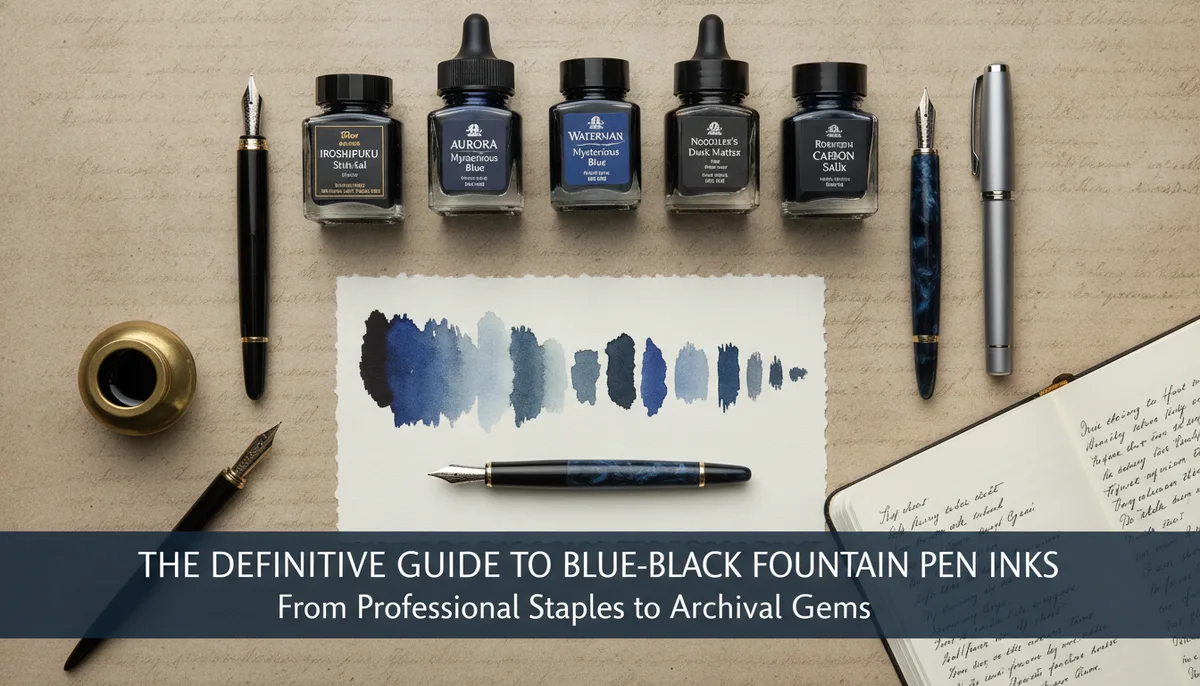
The Definitive Guide to Blue-Black Fountain Pen Inks: From Professional Staples to Archival Gems
Blue-black fountain pen ink strikes the perfect balance between classic and modern. It’s serious without being stuffy, understated but undeniably stylish. For the professional, it offers a level of sophistication that pure black sometimes lacks; for the enthusiast, it provides a canvas for shading and character that makes every sentence unique. If you're wondering which one belongs in your collection, you’re in the right place.
The appeal of blue-black lies in its versatility. It is formal enough for a boardroom yet expressive enough for a midnight journal entry. However, not all blue-blacks are created equal. Some lean toward a dusty teal, others toward a deep midnight navy, and some are engineered specifically to survive a flood. Understanding the chemistry and "personality" of these inks is the first step in finding your perfect daily driver.
The Origin and Evolution of Blue-Black Inks
The history of blue-black ink is rooted in necessity. In the era of traditional iron gall inks, the fluid was often quite pale when first applied to the paper, only darkening to a deep black as it oxidized. To help writers see what they were doing in real-time, manufacturers added blue dyes to the formula. This created a "blue-black" effect: the ink went down blue and matured into black.
Today, modern chemistry has given us a massive variety of ways to achieve this aesthetic. We no longer rely solely on iron gall; we have pH-neutral dyes, nano-pigments, and "bulletproof" cellulose-reactive formulas. Whether you are looking for the historical charm of a maturing ink or the high-tech reliability of a document-grade fluid, the blue-black category has something to offer.
When choosing an ink, it is also essential to consider the surface you are writing on. A high-quality ink performs best on paper designed to handle liquid fountain pen ink without feathering. For more on optimizing your writing experience, see our guide on Finding Your Perfect Match: A Comprehensive Guide to Selecting the Best Journal for Your Writing Ritual.
The Traditionalist’s Choice: Iron Gall and Archival Formulas
For those who appreciate the weight of history, iron gall inks remain a fascinating choice. These inks are prized for their permanence and the unique way they interact with the paper.
Rohrer & Klingner Salix
Rohrer & Klingner Salix is as close as you can get to a traditional iron gall fountain pen ink in modern times. It writes a soft, dusty blue at first, but darkens over time as it oxidizes into a rich, archival black. The ink is water-resistant, fade-proof, and made to stand the test of time. It’s perfect for historians, journalers, or anyone who wants to see their words age like fine wine. Because it is an iron gall ink, it is exceptionally well-behaved on lower-quality paper, resisting the "feathering" that often plagues wetter inks.
De Atramentis Document Ink Black Blue
If your priority is absolute security, De Atramentis Document Ink Black Blue is the gold standard. It’s part of the brand's document line, known for waterproof, fade-resistant, and tamper-proof properties. This ink is designed to meet strict archival standards, making it ideal for official records or signatures that must last for decades. The color is dark, intense, and leans heavily on the black side of blue-black. It’s not flashy, but it’s fiercely functional.
De Atramentis Document Ink Black Blue
The Performance Workhorses: Reliability for Every Day
Not every writing session requires archival permanence. Sometimes, you just need an ink that works every time you touch the nib to the paper, regardless of the pen you are using.
Pilot Iroshizuku Shin-kai
If you're looking for an ink that behaves beautifully in just about any pen, Pilot Iroshizuku Shin-kai is the shade for you. Part of Pilot’s premium Iroshizuku line, Shin-kai (which translates to "Deep Sea") flows smoothly, dries quickly, and rarely feathers or bleeds. The color is a gorgeous navy with subtle shading, striking that ideal balance between sophistication and personality. Shin-kai is the blue-black ink you reach for when you want something that’s elegant, easy to clean, and consistently satisfying. It is often cited by enthusiasts as one of the most "well-lubricated" inks on the market, making even scratchy nibs feel smoother.
TWSBI Blue-Black
Don’t let the frosty, futuristic bottle distract you! TWSBI Blue-Black is a solid, workhorse ink. It sits right in the middle of the blue-black spectrum, with balanced shading and just enough character to keep things interesting. The ink flows reliably, doesn’t stain, and comes in a generous 70ml bottle, making it a great value pick. If you’re a fan of TWSBI pens, you’ll love how this ink complements their modern aesthetic, but it performs just as well in a vintage Parker or a high-end Pelikan.
TWSBI Blue-Black Ink 70ml
Permanent Power: Pigmented and Bulletproof Picks
For many, the fear of a spilled coffee or a rainstorm ruining a notebook is enough to swear off standard dye-based inks forever. This is where pigmented and "bulletproof" inks shine.
Noodler’s 54th Massachusetts
One of the most popular blue-black inks on the market, Noodler’s 54th Massachusetts is beloved for its waterproof, fade-resistant, and fraud-resistant formula. It is part of Noodler's "bulletproof" line, meaning it binds with the cellulose in the paper to become nearly impossible to remove. The color leans dark and serious, more black than blue, making it perfect for professional documents or moody journaling. It’s a no-nonsense choice for serious ink lovers who need their words to last forever.
Sailor Seiboku and Souboku
Sailor offers two distinct paths for fans of pigmented inks. These inks use nano-pigments that offer incredible water resistance without the maintenance headaches typically associated with older pigment formulas.
- Sailor Seiboku Pigmented Blue Black: This ink brings the vibrancy of a true blue with the permanence of a pigmented ink. It’s waterproof, smudge-resistant, and safe for most fountain pens despite the pigment. The color leans blue with a subtle black undertone, making it one of the brightest and most vibrant options in the blue-black category. It is also famous for its incredible "sheen" on fountain-pen-friendly paper.
- Sailor Souboku Pigmented Deep Blue: If Seiboku is your bright and bubbly friend, Souboku is their introspective, moody sibling. This ink is slightly darker and more subdued, leaning toward true blue-black territory. It’s still pigmented and waterproof, offering the same permanence and reliability, but with a deeper, richer tone.
Specialty Inks for Unique Writing Needs
Sometimes, the standard properties of ink aren't enough. You might need an ink that handles a specific pen quirk or provides a specific visual "vibe."
Private Reserve Infinity Blue/Black
Prefer an ink that flows fast and free? Private Reserve Infinity Blue/Black might be your perfect match. This is one of the wettest blue-black inks in the lineup, making it ideal for dry pens or heavy writers. The standout feature, however, is the "Infinity" formula. It is designed to resist drying out in your nib, which is great for infrequent writers or multitaskers who forget to cap their pens during a long meeting.
LAMY Benitoite
LAMY benitoite ink is what most people imagine when they hear the term “blue-black.” It is a sophisticated, grey-leaning blue that feels very European and classic. Part of LAMY's Crystal Ink line, it offers excellent shading and a very professional appearance. It is a dry-leaning ink, which makes it a fantastic pairing for broader nibs or pens that tend to gush too much ink onto the page.
Understanding the difference between these flow characteristics is vital for enthusiasts. For more on how different pen types interact with ink, check out our comparison of Fountain Pens vs. Calligraphy Pens: Understanding the Essential Differences for Enthusiasts.
Maintenance and Care for Blue-Black Inks
While blue-black inks are generally reliable, the very properties that make them great—permanence, high saturation, and iron gall chemistry—require a bit more attention than a standard royal blue.
- Regular Flushing: If you are using permanent inks like Noodler's 54th Massachusetts or pigmented inks like Sailor Seiboku, aim to flush your pen with cool water every 2-4 weeks. This prevents any particles from settling in the feed.
- Cap Your Pens: Even with "Infinity" formulas, it is best practice to cap your pen when not in use. Blue-black inks often have a high dye load, and evaporation can lead to "nib creep" or hard starts.
- Compatibility Checks: Before using a highly permanent or iron gall ink in a rare vintage pen with a latex sac, check for compatibility. Modern converters and piston fillers are generally much more resilient.
- Highlighter Use: If you plan on highlighting your notes, ensure your blue-black ink is fully dry. Pigmented and bulletproof inks are the best candidates for this. You can learn more about this in The Ultimate Guide to Highlighter Pens: Why Compatibility and Tip Design Matter.
Conclusion: Finding Your Signature Shade
The world of blue-black ink is vast because the "perfect" blue-black is subjective. For the lawyer signing contracts, De Atramentis Document Black Blue provides the necessary security. For the student taking rapid-fire notes, Pilot Iroshizuku Shin-kai offers the smoothest flow. And for the artist who wants their sketches to survive the ages, Sailor Seiboku provides a vibrant, waterproof finish.
Blue-black is more than just a color; it’s a tool for communication that carries the weight of tradition while embracing modern performance. Whether you prefer the moody, dark tones of Noodler's 54th Massachusetts or the dusty, changing nature of Rohrer & Klingner Salix, there is a blue-black ink waiting to become the signature of your writing ritual. Choose the one that speaks to your style, and enjoy the timeless elegance of a classic redefined.